

Hyaluronic acid is the most famous hydrating ingredient in skincare. It has the better name, the better story, and roughly all of the marketing budget. Glycerin has none of that. It is cheap, it has been in cosmetics for over a century, and it appears in the second or third position on thousands of ingredient lists without ever being mentioned on the front of the bottle.
It is also, by most measures, the better-evidenced humectant of the two. Not the more impressive-sounding one. The better-evidenced one.
That gap between reputation and performance is worth understanding, because it is a small lesson in how skincare marketing actually works.
What a humectant does
Both glycerin and hyaluronic acid are humectants: molecules that bind water and hold it. In skin, that means drawing water into the upper layers and keeping it there rather than letting it evaporate away. Hydrated skin looks plumper, feels more comfortable, and — because the enzymes that maintain a healthy barrier need water to function — actually works better as a barrier.
The differences between the two come down to molecule size, where the water comes from, and what happens in dry air.
Size, and where the water comes from
Glycerin is small. It is a three-carbon molecule, and its size lets it move into the stratum corneum rather than sitting entirely on top of it. Once there, it does something more interesting than simply holding water: research suggests glycerin also supports the skin's own moisturizing machinery — helping maintain the lipid organization of the barrier and the enzymes involved in normal desquamation. It is not purely a sponge. It participates.
Hyaluronic acid is enormous by comparison, and its molecular weight varies enormously by grade. High-molecular-weight HA is far too large to penetrate; it forms a hydrating film on the surface, which is genuinely useful — surface films reduce water loss and smooth the look of skin immediately. Lower-weight fragments are small enough to reach the upper epidermis. This is why multi-weight HA formulas exist: different sizes work at different depths, and one grade alone covers less ground.
Both approaches are legitimate. They are just not the same approach.
The dry-air problem
Here is the practical difference that matters most, and it is the one least often explained.
A humectant pulls water from wherever water is available. In humid conditions, some of that comes from the air. In dry conditions — a Montana winter, an airplane cabin, a heated room in January — there is very little water in the air to pull, and a humectant applied to dry skin can end up drawing moisture from deeper in the skin toward the surface, where it evaporates. The result is a product that was supposed to hydrate leaving skin feeling tighter than before.
This affects hyaluronic acid more visibly than glycerin, partly because HA is so often sold as a standalone serum applied to bare skin, and partly because glycerin's smaller size and barrier interaction make it less dependent on ambient humidity.
The fix is the same in both cases and takes no extra products: apply humectants to slightly damp skin, and seal them with a moisturizer. The damp skin gives the humectant water to grab. The moisturizer on top stops it leaving. A hydrating serum applied to bone-dry skin and left unsealed is the single most common way people get worse results from a good product.
Why “cheap” became a criticism
Glycerin costs very little. That is a manufacturing fact, and it has quietly become a marketing liability — an ingredient that costs nothing is hard to build a premium story around, so brands lead with the expensive-sounding one and let glycerin sit unmentioned in third position.
But cost has no relationship to efficacy. Glycerin is inexpensive because it is easy to produce at scale, not because it works poorly. Judging an ingredient by its price is exactly the reasoning skincare marketing depends on you doing, and it is worth refusing on principle.
The useful question is never “is this ingredient expensive.” It is “is this ingredient doing something, at a dose that matters, in a formula built around it.”
What we did, and why both
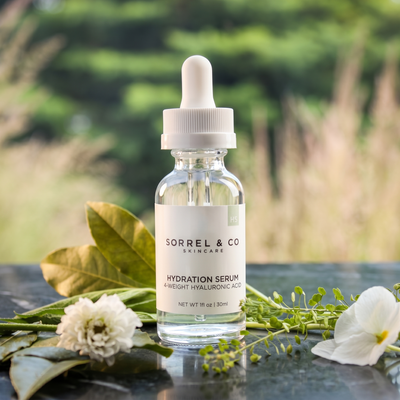
Our Hydration Serum uses four molecular weights of hyaluronic acid — high weight holding water at the surface, medium reaching the upper epidermis, low and ultra-low reaching progressively deeper — and glycerin alongside them, sitting third on the ingredient list.
We grade both Strongest, which is the top of our scale and a grade we hand out sparingly. You can read how the grading works in our research library.
The reason for both rather than either is that they are not redundant. The HA network is a layered water reservoir across depths. Glycerin holds water at the surface during application and supports the barrier itself. Choosing one over the other would mean giving up something real to make the ingredient list read more fashionably, and that is a bad trade.
How to actually use a hydrating serum
Damp skin, always. Straight after cleansing, before the water has fully evaporated. A few drops, pressed rather than rubbed.
Then seal it. Moisturizer over the top, within a minute or two, every time. In genuinely dry air this is not optional — an unsealed humectant in low humidity can leave you worse off than doing nothing.
And give it a realistic job. Hydration is not the same as barrier repair, and it is not the same as treating a concern. It makes skin look plumper and feel more comfortable, quickly and reversibly. That is a real benefit, worth having every day. It is not a transformation, and a serum promising one is describing something other than what humectants do.
If you would rather have the whole routine mapped than assembled piece by piece, the Skin Plan maps yours in about thirty seconds — no email required.
References
- Fluhr JW, et al. Glycerol and the skin: holistic approach to its origin and functions. Br J Dermatol. 2008. pubmed.ncbi.nlm.nih.gov/18510666
- Pavicic T, et al. Efficacy of cream-based novel formulations of hyaluronic acid of different molecular weights in anti-wrinkle treatment. J Drugs Dermatol. 2011. pubmed.ncbi.nlm.nih.gov/22052267
- Spada F, et al. Skin hydration is significantly increased by a cream formulated to mimic the skin's own natural moisturizing systems. Clin Cosmet Investig Dermatol. 2018. pubmed.ncbi.nlm.nih.gov/30410378