

“Eye cream” is one of the least useful product categories in skincare, not because the eye area does not need care, but because the category collapses three unrelated problems into one shelf. Dark circles, puffiness, and fine lines have almost nothing to do with each other. They have different causes, different timelines, and different honest answers — and a single cream cannot address all three equally, whatever the box says.
So the first useful step is identifying which one you actually have. Often it is two, which is fine, as long as you know they are two.
Dark circles: mostly vascular, sometimes pigment, sometimes shadow
Dark circles are the most misdiagnosed of the three, because at least three different things produce the same look.
The most common is vascular. The skin under the eye is the thinnest on the body, and beneath it sits a dense network of small blood vessels. When those vessels are dilated or congested — from fatigue, poor sleep, allergies, crying, dehydration — the bluish-purple tint shows through skin too thin to conceal it. This kind of circle worsens with tiredness and often looks better after a good night's sleep, which is the diagnostic tell.
The second is pigmentary: actual melanin deposition in the under-eye skin. It is more common in deeper skin tones, frequently runs in families, and does not fluctuate with sleep. If your circles look brown rather than blue and look about the same on your best-rested day, this is likely the type.
The third is not a circle at all — it is shadow. As the face ages, the fat pads under the eye lose volume and the tear trough deepens, and a hollow casts a shadow that reads as darkness. The test is a mirror and a light: tilt your face upward toward the light, and if the darkness largely vanishes, you were looking at topography, not pigment.
Why this matters: only the pigmentary type responds meaningfully to topical brightening ingredients. Vascular circles respond a little to anything that supports skin thickness and quality over time, and to managing the causes — sleep, allergies, hydration. Shadow does not respond to skincare at all, because there is nothing on the surface to change. Any product promising to erase all dark circles is promising to fix a bone-and-fat-pad problem with a cream.
Puffiness: fluid, and mostly about the last twelve hours
Puffiness is a fluid problem. Lymphatic drainage around the eye is sluggish overnight, particularly if you sleep flat, and salt, alcohol, hormonal shifts, and allergies all push more fluid into the tissue. That is why puffiness is characteristically worst in the morning and settles over a few hours upright.
Because it is fluid and not structure, puffiness is the most changeable of the three — and the most responsive to non-product interventions. Sleeping with your head slightly elevated, cold applied briefly in the morning, and reducing the previous evening's salt will each do measurably more than most creams.
There is also a permanent version, which is not fluid at all: with age, the fat pads that cushion the eye can herniate forward through a weakening membrane, producing a bulge that is present all day and does not change with sleep or salt. That is a structural change, and it is a surgical question, not a skincare one. The honest distinction is simple — if it is different at 8am and 3pm, it is fluid; if it is identical, it is structure.
Fine lines: the one that behaves like the rest of the face
Fine lines around the eyes are the most straightforward of the three, because they are the same phenomenon as fine lines anywhere else, just arriving earlier. The skin here is thinner, has fewer oil glands to keep it supple, and is folded thousands of times a day by blinking and expression. Add sun exposure — the eye area is chronically under-protected because people avoid putting sunscreen close to the eye — and lines simply show up here first.
Because the mechanism is ordinary, so are the useful ingredients: consistent hydration, ingredients that support the look of smoother skin over time, and above all sun protection. This is the category where topical care legitimately does the most.
What our Eye Cream does, and what it doesn't
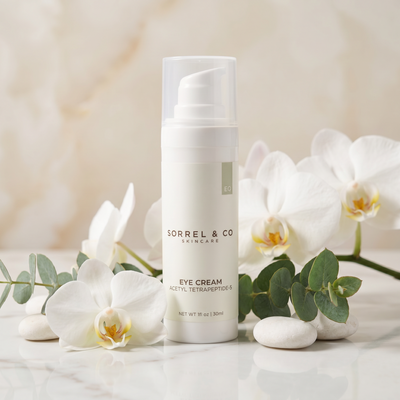
The Eye Cream is built around Acetyl Tetrapeptide-5, a signal peptide studied specifically for the appearance of under-eye puffiness over several weeks of consistent use, with sodium hyaluronate for hydration and grape seed oil as a light antioxidant conditioner. We grade the peptide Strong and the grape seed oil Mixed, and both grades are published on the page.
So, plainly: it is aimed at the puffiness-and-smoothness end of this article. It is a reasonable choice if your complaint is a tired, puffy look and lines that have started to show. It is not a treatment for pigmentary dark circles, it will not fill a tear-trough hollow, and it will not do anything about herniated fat pads. No topical will do the last two, ours included.
Honest timelines
If you are going to use anything here, calibrate your expectations to the mechanism. Hydration-driven smoothness shows up fastest — days to a couple of weeks, and it is partly a plumping-with-water effect, which is real but reversible. Peptide-driven changes in the look of puffiness are studied over roughly four to eight weeks of daily use. Anything involving the look of pigment is a months-long proposition, because it is bound to skin cell turnover. And structural change is not on the menu.
Two things outperform every eye product for two of the three problems: sleeping well and wearing sunscreen. That is not a very sellable sentence, which is probably why you rarely read it on a box.
If you want help sorting which of the three you are actually dealing with and what belongs in your routine, the Skin Plan maps your routine in about thirty seconds — no email required.
References
- Ferreira MS, et al. Trending anti-aging peptides. Cosmetics. 2020. doi.org/10.3390/cosmetics7040091
- Pavicic T, et al. Efficacy of cream-based novel formulations of hyaluronic acid of different molecular weights in anti-wrinkle treatment. J Drugs Dermatol. 2011. pubmed.ncbi.nlm.nih.gov/22052267
- Yarovaya L, et al. Clinical study of grape seed extract in cosmetic formulations. J Cosmet Dermatol. 2021. pubmed.ncbi.nlm.nih.gov/32892461